Novah / The one-hour reset
How to descale a kettle. A measured pause for the chalky bits.
Those little pale flakes are not a surprise tea ingredient. Limescale is easier to dissolve than to scrape. Measure a mild descaling solution, warm it gently and let the kettle take an hour off.
Go to the steps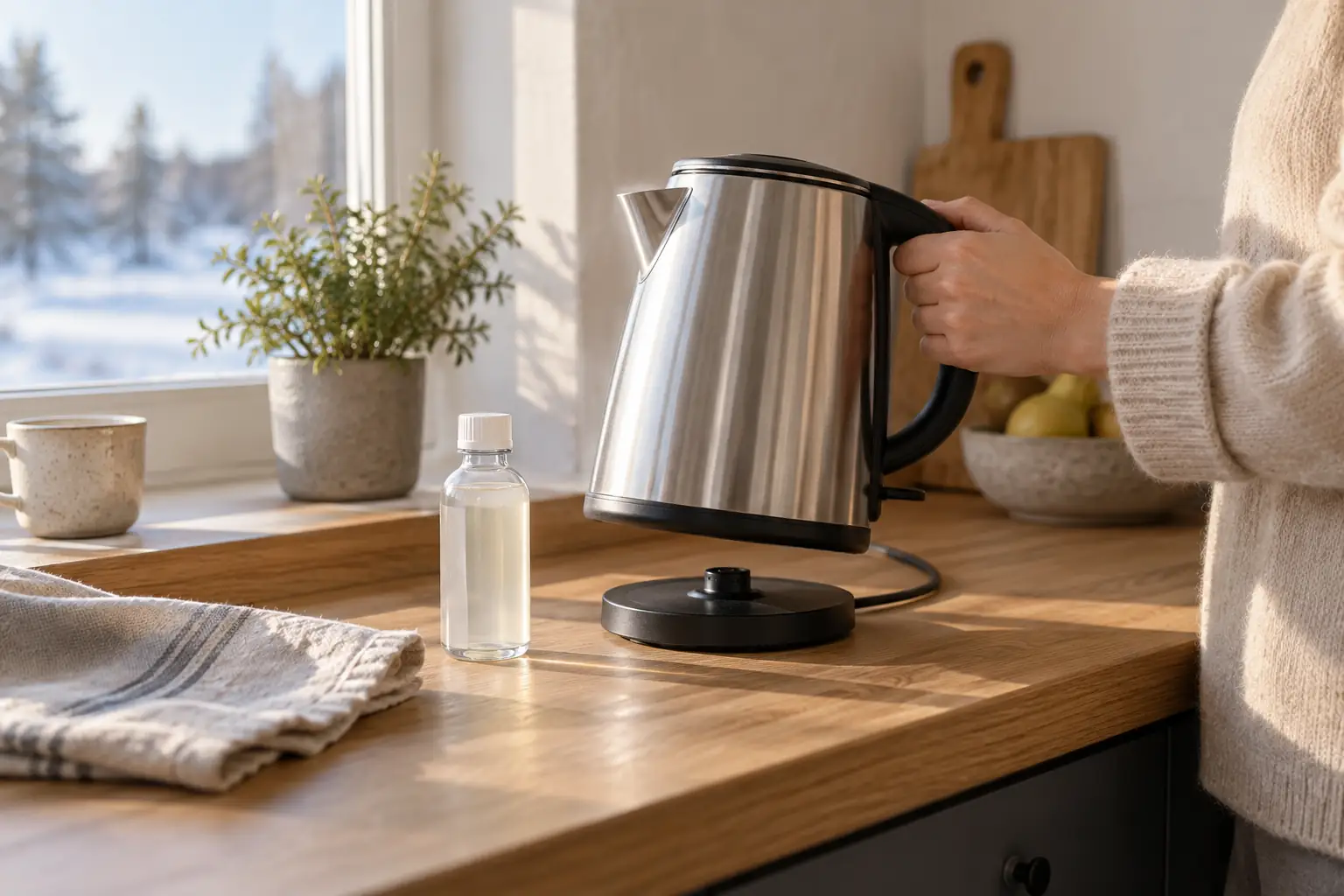
50 ml descaler + 500 ml water. One hour, then rinse.
Use Wilfa Brewfresh Universal Descaler WICD-250 at 50 ml per 500 ml water. For a kettle that permits this descaler, bring the solution to 40–50°C, switch off, unplug and leave for one hour. Empty carefully and rinse thoroughly with fresh water before use. Do not boil the descaling solution, submerge the base or scrape the bottom with metal.
The job, at a glance
The kettle's slow, gentle clean
For ordinary uncoated kettle interiors that accept commercial kettle descaler. A 50°C temperature setting, such as on KitchenAid 5KEK1701, makes the warming stage straightforward. A coated interior or a prohibition on descaler needs a different method.
- Descaler + water
- 50 + 500 mlWilfa's dilution for the exact WICD-250 bottle.
- Warm, not boiling
- 40–50°CThe product's specified temperature range.
- Leave to work
- 1 hourWilfa's kettle contact time, with the power off.
KitchenAid 5KEK1701: use the 50°C setting
This model's temperature range starts at 50°C. Select that setting, not a tea preset or boil. Keep the measured solution between the kettle's minimum and maximum marks, stop heating once warm and move it off the base for the one-hour contact.
Bosch TWK8613P: its lowest preset is hotter
The Bosch example has 70°C as its lowest preset. Do not select that and call it 50°C. Use a thermometer and stop the warming early, or choose the Bosch-specific vinegar method separately. Do not mix vinegar into this Brewfresh recipe.
Buy only what is missing
One descaler. A clear measuring job.
The same WICD-250 bottle can be used for the worked coffee-maker guide, but the kettle's temperature and one-hour waiting stage are different. Do not carry a coffee-brewing cycle over to this task.
A practical choice
Wilfa Brewfresh Universal Descaler
250 ml bottle, WICD-250
50 ml per 500 ml water, warmed to 40–50°C and left for one hour.
Optional
SINI Yleisliina microfiber cloth
One 30 × 30 cm cloth
Optional exterior wipe. Keep the base and contacts dry.
Retailer prices were checked on the dates shown and may change. These are shopping suggestions, not products sold by Novah. Check delivery and local store stock before buying.
01 / Before you start
Warm liquid. Dry electrics.
The important boundary is simple: the cleaning solution belongs inside the jug, never around the base or connector.
Visible scale
Check where the deposits are. The measured solution must cover them without exceeding the maximum fill line. If more solution is needed, keep the same 50 ml per 500 ml water ratio.
A temperature you can check
Use the 50°C preset when present. With a simple boiling kettle, warm briefly, switch off and lift from the base before checking with a kitchen thermometer. Do not guess a universal heating time.
One product only
Keep vinegar, bleach, dish soap and other descalers out of this mixture. The stated dose and wait belong to WICD-250, not every bottle called descaler.
02 / The steps
Let the solution do the scraping for you.
The active work is short. The full hour is the product's waiting time, not an estimate.
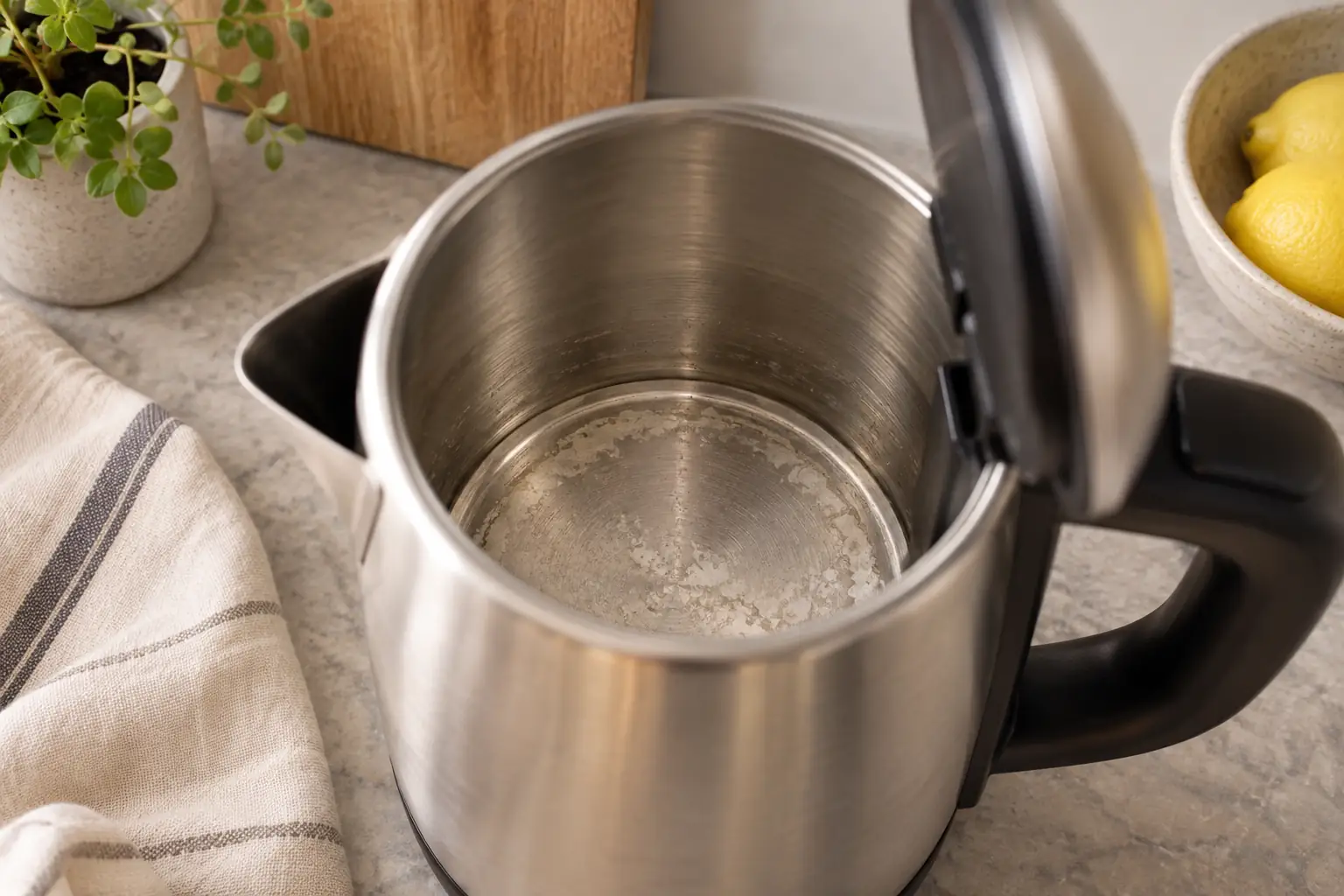
Empty the cool kettle and inspect.
Switch off and unplug. Empty leftover water and look at the scale level. Keep the exterior, base and electrical connector dry. Do not pick at deposits with a spoon or knife.
Measure the solution separately.
Mix 50 ml WICD-250 with 500 ml water in a clean jug. Pour it into the kettle and check it covers the deposits while staying within the fill limits. For one litre of water, use 100 ml descaler instead; never exceed the maximum.
Guidance from: Wilfa · Brewfresh kettle dose and one-hour contact time (opens in a new tab)
Warm the solution to 40–50°C.
Set a suitable temperature-controlled kettle to 50°C. With no matching setting, stop heating early, take the kettle off the base and check the liquid with a kitchen thermometer. Remove the probe before any further warming. Do not allow the solution to boil.
Guidance from: Wilfa · Brewfresh kettle dose and one-hour contact time (opens in a new tab)KitchenAid · 5KEK1701, 50–100°C settings (opens in a new tab)
Switch off and leave for one hour.
Unplug the base and take the kettle off it. Leave the warm solution inside for one hour, safely away from children and anyone making tea. Keep-warm mode stays off. Set an ordinary phone or kitchen timer; this is an excellent time to do nothing to the kettle.
Guidance from: Wilfa · Brewfresh kettle dose and one-hour contact time (opens in a new tab)
Empty and rinse thoroughly.
Pour away the used solution carefully. Fill with clean water, move it gently around the interior and empty. Repeat the fresh-water rinse so no product remains. Rinse the pouring lip too. Do not taste the liquid to check whether the product has gone.
Inspect, wipe and reconnect dry.
Look at the bottom and the sides once rinsed. If substantial scale remains, repeat a fresh correctly diluted treatment rather than doubling the strength. Wipe the outside with a well-wrung cloth, dry the base and connector area, and reconnect only when dry.
The stronger shortcut is usually the wrong shortcut.
Boiling this product
Brewfresh's kettle instructions specify 40–50°C and one hour. Boiling is not a faster version of that recipe.
Extra concentrated acid
More product is not automatically more useful. Repeat the correct mixture if needed instead of increasing its strength.
Scraping the heating plate
Hard or metal tools can damage the surface. Dissolve the scale, rinse and inspect.
03 / The finishing touch
Tea can take over again.
A clean kettle has no loose scale or descaler residue and its electrical contact area is dry. How quickly scale returns depends on water hardness and use, so inspect the bottom rather than following an invented weekly deadline.
- The one-hour treatment is finished.
- The interior and pouring lip have been thoroughly rinsed.
- The outside, base and connector are dry before power returns.
04 / Questions
Questions
Can I use boiling water to save time?
Not with this recipe. Wilfa specifies warming to 40–50°C and leaving for one hour. A separate product may have a different method, but do not combine methods.
Guidance from: Wilfa · Brewfresh kettle dose and one-hour contact time (opens in a new tab)
What if my kettle only boils?
Use a kitchen thermometer after switching off and removing the kettle from the base to check the warming stage. If you cannot check the temperature or the kettle does not permit this product, choose a complete recipe designed for your exact kettle and cleaner instead of guessing.
Are the pale flakes dirt?
They are commonly mineral scale from the water. Descaling dissolves those mineral deposits; it does not repair a damaged heater, coating or electrical fault.
Can I use the coffee-maker instructions instead?
The product dilution matches, but the procedure does not. A kettle holds the warmed solution for an hour, whereas the worked filter brewer runs solution through its internal water path. Use each appliance's own sequence.
Guidance from: Wilfa · Brewfresh kettle dose and one-hour contact time (opens in a new tab)
Sources & material instructions
Novah
Leave the rest of the home to us.
Keep this guide for the small jobs between visits. If you would like help with everyday home cleaning in Helsinki, Espoo or Vantaa, tell us what your home needs. Specialist appliance servicing and textile restoration are separate tasks.
Talk to Novah